
How Long Do Leftovers Last in the Fridge? A Food Safety Chart
Most cooked leftovers keep 3 to 4 days in the refrigerator. That is the USDA Food Safety and Inspection Service (FSIS) guideline, and it covers the bulk of what ends up in a storage container: roast chicken, chili, pasta bake, stir-fry, pizza. A few foods get a little more time, a few get less, and all of them depend on how fast they got cold in the first place. The chart below covers the common ones, followed by the rules for cooling, freezing, and reheating that make those numbers hold.
The short answer: 3 to 4 days
FSIS says leftovers can be kept in the refrigerator for 3 to 4 days or frozen for 3 to 4 months. The fridge number is about safety. Bacteria still grow slowly at refrigerator temperature, so after about four days the risk climbs even if the food looks and smells fine. The freezer number is about quality: FSIS notes that food kept constantly at 0°F stays safe indefinitely, but it slowly loses moisture and flavor.
Two conditions sit underneath the 3 to 4 day rule:
- Your refrigerator is at 40°F or below. FSIS recommends checking it with an appliance thermometer rather than trusting the dial.
- The food went into the fridge within 2 hours of cooking. If it sat out longer, the clock is already used up.
The 2-hour rule (and the 1-hour rule)
Bacteria grow fastest between 40°F and 140°F, the range FSIS calls the danger zone. Cooked food needs to be refrigerated within 2 hours of cooking, or within 2 hours of coming off a warming tray or slow cooker. If the room or outdoor temperature is above 90°F, as at a summer picnic, the limit drops to 1 hour.
Perishable food that has been at room temperature longer than that should be thrown out, not refrigerated. Chilling it afterward does not undo the bacterial growth that already happened.
Leftovers food safety chart
Times assume a refrigerator at 40°F or below and a freezer at 0°F. Freezer times are for best quality; frozen food held at 0°F stays safe longer, but it gets drier and blander. Figures come from the FoodSafety.gov cold storage chart and the USDA FoodKeeper data.
| Leftover | Refrigerator (40°F) | Freezer (0°F) |
|---|---|---|
| Cooked meat or poultry (roast chicken, turkey, pot roast, pork chops) | 3 to 4 days | 2 to 6 months |
| Chicken nuggets or patties | 3 to 4 days | 1 to 3 months |
| Cooked fish | 3 to 4 days | 1 to 2 months |
| Soups and stews, with vegetables or meat | 3 to 4 days | 2 to 3 months |
| Homemade broth | 3 to 4 days | 2 to 3 months |
| Pizza | 3 to 4 days | 1 to 2 months |
| Casseroles with eggs, after baking | 3 to 4 days | 2 to 3 months |
| Quiche, after baking | 3 to 5 days | 2 to 3 months |
| Cooked pasta | 3 to 5 days | 1 to 2 months |
| Cooked rice | 4 to 6 days | 6 months |
| Cooked vegetables and potatoes (no meat, fish, or egg) | 3 to 4 days | 1 to 2 months |
| Egg, chicken, ham, tuna, and macaroni salads | 3 to 4 days | Does not freeze well |
| Hard-cooked eggs | 1 week | Do not freeze |
| Cooked ham, store-wrapped slices or spiral cut | 3 to 5 days | 1 to 2 months |
| Deli meat, opened or sliced at the counter | 3 to 5 days | 1 to 2 months |
| Pumpkin or pecan pie, after baking | 3 to 4 days | 1 to 2 months |
If a dish combines categories, go with the shortest time of anything in it. A rice bowl topped with chicken is a 3 to 4 day leftover, not a 4 to 6 day one.
Cool leftovers fast
The 3 to 4 day count only works if food gets cold quickly. A big, deep pot of soup can stay warm in the middle for hours, even inside a fridge. FSIS recommends:
- Divide large amounts into shallow containers. Small, shallow portions chill much faster than one deep one.
- Cut big items down. Slice roasts and hams into smaller pieces. For a whole turkey, carve it, slice the breast meat, and refrigerate; legs and wings can stay whole.
- Use an ice bath if you want to speed things up. Setting a pot or container in ice water before refrigerating chills it quickly.
- Do not wait for food to reach room temperature. Hot food can go straight into the refrigerator.
How to store leftovers
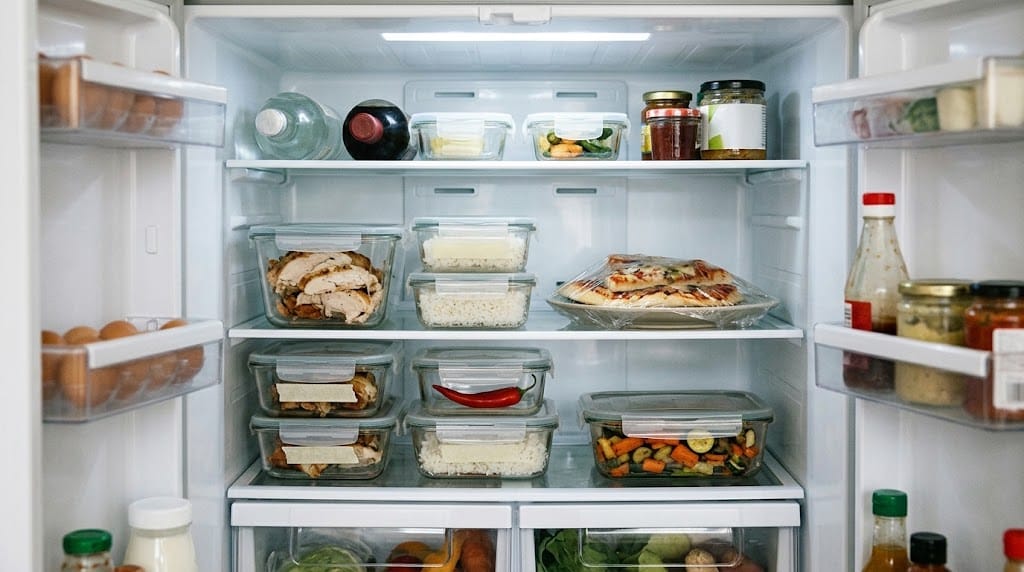
Cover leftovers, wrap them in airtight packaging, or seal them in storage containers. FSIS points out that this keeps bacteria out, holds in moisture, and stops leftovers from picking up odors from the rest of the fridge. Put them in the refrigerator or freezer right away.
Write the date on the lid or a strip of tape. It takes five seconds and ends the "when did we make this?" debate on day four.
Freezing leftovers
If you will not eat something within 3 to 4 days, freeze it early rather than late. FSIS notes that food frozen at peak quality tastes better after thawing than food frozen near the end of its fridge life. A few practical points from FSIS guidance:
- Use airtight, moisture-resistant packaging to prevent freezer burn. Freezer burn (dry, grayish-brown leathery spots) is a quality problem, not a safety one; you can cut those spots away.
- Spread new packages out in a single layer until they are frozen solid, then stack them.
- Some foods do not freeze well at all, including mayonnaise, cream sauces, and lettuce. Mayo-based salads belong in the "eat it this week" category.
Soups, stews, and chili are among the easiest leftovers to freeze in portions. Our weeknight beef chili, for example, freezes well for about 3 months.
Thawing leftovers safely
FSIS lists three safe ways to thaw frozen leftovers:
- In the refrigerator. Slowest, but the food stays safe the whole time. After thawing, use it within 3 to 4 days, or refreeze it.
- In cold water. Faster. The food must be in a leak-proof bag, and it should be cooked or reheated before refreezing.
- In the microwave. Fastest. Keep heating until the food reaches 165°F, then serve it or refreeze it.
You can also skip thawing. FSIS says it is safe to reheat frozen leftovers straight from the freezer: soups and stews in a saucepan or microwave, casseroles in the oven or microwave. It just takes longer.
Never thaw food on the counter, outdoors, or in the garage. Those methods let the outside of the food sit in the danger zone while the middle is still frozen.
Reheating leftovers to 165°F
When you reheat leftovers, FSIS says they should reach 165°F, measured with a food thermometer. That is the same number on our meat cooking temperatures chart, and an instant-read thermometer is the tool that makes it a fact instead of a guess (it is on our essential kitchen tools list for this reason).
- Sauces, soups, and gravies: bring them to a rolling boil.
- Cover food while reheating. Covering keeps moisture in and helps food heat all the way through.
- In the microwave: arrange food evenly in a covered, microwave-safe dish, add a little liquid if needed, vent the lid, and rotate or stir partway. Microwaves leave cold spots, so let the food rest briefly and check the temperature in several places.
Rice and pasta tighten up in the fridge. A splash of water or broth before reheating, as we suggest for our one-pan lemon garlic chicken and rice, brings the texture back.
Can you refreeze leftovers?
Yes, in two situations covered by FSIS guidance:
- Leftovers that were frozen, then reheated to 165°F, can be frozen again if any remain.
- If you thaw a large container in the refrigerator and only need part of it, you can take out what you need and refreeze the rest without reheating it.
Food thawed in cold water or in the microwave should be cooked or reheated before it goes back in the freezer.
When in doubt, throw it out
If you cannot remember when something was cooked, or it sat out through a long dinner, the safe call is the trash. Labeling containers with the date is the simplest way to avoid that guessing game. If someone in your household becomes sick after eating leftovers, especially a young child, an older adult, a pregnant person, or anyone with a weakened immune system, call a doctor.
For food safety questions about meat, poultry, and eggs, the USDA Meat and Poultry Hotline is available at 1-888-MPHotline (1-888-674-6854).
FAQ
Is it safe to eat leftovers after 5 days?
For most cooked leftovers, USDA guidance is 3 to 4 days in the refrigerator. A few items, such as cooked pasta, quiche, and cooked rice, are listed for a bit longer in the FoodKeeper data. If a leftover has passed its window, throw it out or, next time, freeze it before day four.
Does the 3 to 4 day count start when food is cooked or when it goes in the fridge?
Count from when it was cooked. The 3 to 4 day guideline assumes the food was refrigerated within 2 hours of cooking. Food that sat out longer than that should not be saved at all.
Can I put hot food directly in the refrigerator?
Yes. FSIS says hot food can go straight into the refrigerator. For large amounts, divide it into shallow containers first so it cools quickly.
How long do Thanksgiving leftovers last?
Cooked turkey and other cooked poultry keep 3 to 4 days in the fridge, as do most cooked side dishes. Pumpkin and pecan pie also keep 3 to 4 days refrigerated after baking. Carve the turkey off the bone before refrigerating so it cools quickly.
Do I need to thaw frozen leftovers before reheating?
No. FSIS says it is safe to reheat frozen leftovers without thawing. It takes longer, and the food still needs to reach 165°F.
Sources
More like this in your inbox
The Weekly Meal Plan: five dinners and a grocery list, plus new recipes.