
How Long to Thaw a Turkey: A Day-by-Day Thanksgiving Timeline
A frozen turkey thaws on its own schedule, not yours. In the refrigerator, the USDA Food Safety and Inspection Service (FSIS) says to allow about 24 hours for every 4 to 5 pounds, which means a 20-pound bird needs to leave the freezer days before most people start thinking about Thanksgiving. Thanksgiving 2026 is Thursday, November 26. Below is how long to thaw a turkey by weight for your Thanksgiving dinner, the date to start for each size, and a day-by-day plan for the week.
Turkey thawing times by weight
These are the FSIS times for a whole turkey. The refrigerator should be set at 40 degrees F (40°F) or below. The "start by" dates count back from Thanksgiving morning using the longer end of each range, so the bird has time to finish even if your fridge runs cold.
| Turkey weight | Refrigerator thaw | Move to fridge by (for Thu, Nov 26) | Cold water thaw |
|---|---|---|---|
| 4 to 12 lb | 1 to 3 days | Monday, Nov 23 | 2 to 6 hours |
| 12 to 16 lb | 3 to 4 days | Sunday, Nov 22 | 6 to 8 hours |
| 16 to 20 lb | 4 to 5 days | Saturday, Nov 21 | 8 to 10 hours |
| 20 to 24 lb | 5 to 6 days | Friday, Nov 20 | 10 to 12 hours |
Starting a day early is fine. FSIS says a turkey thawed in the refrigerator can stay there 1 to 2 days before cooking. Starting a day late is the problem this whole timeline exists to prevent.
The three safe ways to thaw a turkey
FSIS lists three safe methods: the refrigerator, cold water, and the microwave. Thawing on the kitchen counter or in hot water is not safe. Once a turkey starts to thaw, bacteria that were present before freezing can start to grow again, and the outer layer of a bird on the counter sits in the "Danger Zone" of 40°F to 140°F even while the center is still frozen.
1. Refrigerator thawing (the one to plan around)
This is the method FSIS recommends planning for, and the slowest. Thaw your turkey in the fridge and it stays at a safe temperature the whole time.
- Allow about 24 hours for every 4 to 5 pounds.
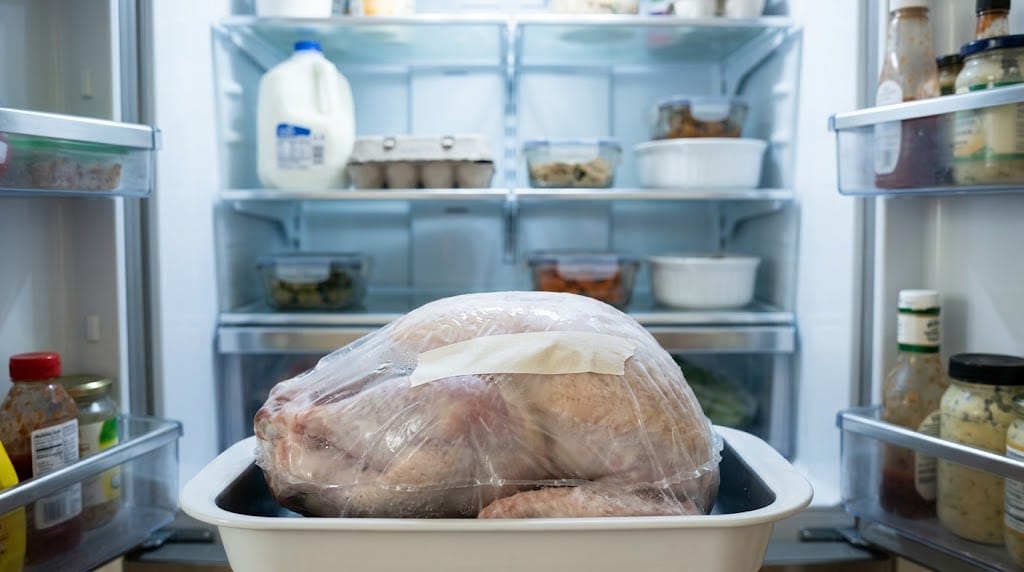
- Leave the turkey in its original wrapping and set it on a tray or in a pan to catch drips, on the bottom shelf so nothing leaks onto other food.
- Once thawed, it keeps 1 to 2 days in the fridge.
- A refrigerator-thawed turkey can be refrozen if plans change, with some loss of quality.
2. Cold water thawing (the backup)
- Allow about 30 minutes per pound.
- Keep the turkey in a leak-proof wrapper or bag so water cannot get in.
- Submerge it completely in cold tap water and change the water every 30 minutes.
- Cook the turkey immediately after it thaws. Do not refreeze it raw.
Cold water is the fastest way to thaw a frozen turkey safely, but a 14-pound turkey still needs about 7 hours of water changes, so this is a plan for an early start on Wednesday or Thursday morning, not a shortcut you can set and forget.
3. Microwave thawing (small birds only)
FSIS notes that a whole turkey rarely fits in a home microwave. For a small turkey or a turkey breast, follow the manufacturer's defrost settings and cook it immediately afterward, because some areas start to cook during microwaving.
Day-by-day Thanksgiving turkey timeline for 2026
Weekend before (Nov 14 and 15): buy and make room
Buy a frozen turkey and put it straight into the freezer when you get home. FSIS says frozen turkeys should not wait on the porch, in the car trunk, or in the garage, where the temperature cannot be controlled. While you are at it, clear a full shelf in the refrigerator. A large turkey in a roasting pan can take most of one.
Friday, Nov 20: 20 to 24 pound turkeys go in the fridge
Set the wrapped turkey breast side up in a rimmed pan on the lowest shelf. Write the date on a piece of tape on the wrapper so everyone in the house knows the clock has started.
Saturday, Nov 21: 16 to 20 pound turkeys
Same setup. If your fridge is crowded or opened constantly, consider moving a bird this size in on Friday instead; a thawed turkey can wait in the fridge 1 to 2 days.
Sunday, Nov 22: 12 to 16 pound turkeys
FSIS's planning guide is 1 pound of turkey per person, so a 14-pound bird covers about 14 people, or fewer people with leftovers.
Monday, Nov 23: 4 to 12 pound turkeys and bone-in breasts
Smaller birds and whole turkey breasts start today. This is also a good day to check your refrigerator temperature with an appliance thermometer; if it runs warmer than 40°F, turn it down.
Tuesday, Nov 24: check progress, buy a fresh turkey
Press the thickest part of the breast through the wrapper. It should be softening at the surface. If you are buying a fresh turkey instead, FSIS says to buy it no earlier than 1 to 2 days before cooking, so Tuesday or Wednesday, unless the package has a "use by" date that covers Thanksgiving.
Wednesday, Nov 25: the deciding day
Reach into the cavity. If you can pull out the neck and giblet bag and the cavity has no ice, you are in good shape. If the center is still frozen solid, switch to cold water tonight or plan on extra cooking time Thursday (see below). Do not leave it on the counter overnight.
Thursday, Nov 26: Thanksgiving
- Remove the neck and giblets from both cavities and cook them separately.
- FSIS does not recommend washing the raw turkey, since rinsing spreads bacteria around the sink and counter.
- Roast at an oven temperature no lower than 325°F until a food thermometer reads 165°F in the thickest part of the breast and the innermost part of the thigh and wing.
- Let it rest 20 minutes before carving.
- FSIS's Meat and Poultry Hotline (1-888-674-6854) is open on Thanksgiving Day from 8 a.m. to 2 p.m. Eastern for questions.
If you plan to brine
Brining adds a step to the schedule, because the turkey has to be thawed before it goes in the brine. Count the brining time when you pick your start day. FSIS says to brine in a food-grade plastic, stainless steel, or glass container or a food-grade brining bag (never a trash bag), with the turkey fully submerged and kept covered in the refrigerator or in a cooler with ice.
What if the turkey is still frozen on Thanksgiving morning?
You have two safe options. First, switch to the cold water method and keep changing the water every 30 minutes; the bird gets cooked as soon as it is thawed. Second, cook it as is. FSIS says it is safe to roast a completely frozen or partially frozen turkey; a fully frozen turkey takes at least 50 percent longer than a thawed one. Pull out the giblet package with tongs partway through roasting, once it loosens. Either way, the thermometer decides when it is done, not the clock. Our meat cooking temperatures chart has the full list of safe temperatures for the rest of the menu.
Thawing mistakes to avoid
- Thawing on the counter. More than 2 hours at room temperature puts the outside of the bird in the Danger Zone.
- Hot water. Same problem, faster.
- Garage, porch, or car trunk. Outdoor temperatures swing too much in November to count on.
- Thawing on a high shelf. Raw turkey juice dripping onto produce or cooked food is a cross-contamination risk. Bottom shelf, in a pan.
- Skipping the thermometer. A pop-up timer is a starting point. FSIS recommends checking the breast, thigh, and wing with a food thermometer too. If you do not own one, an instant-read thermometer is on our essential kitchen tools list.
FAQ
How long does it take to thaw a 20-pound turkey?
In the refrigerator, 4 to 5 days by FSIS times, so move it from the freezer by Saturday, November 21 for a Thursday, November 26 dinner. In cold water, about 10 hours with the water changed every 30 minutes.
Can I thaw a turkey in the refrigerator too early?
A turkey thawed in the refrigerator stays safe there for 1 to 2 days before cooking. If it will be longer than that, you can refreeze a refrigerator-thawed turkey, with some loss of quality.
Is it safe to thaw a turkey in the sink overnight?
Only if you change the cold water every 30 minutes all night and cook the turkey as soon as it is thawed. Letting it sit in standing water that warms up is not safe.
Can I cook a turkey that is still partly frozen?
Yes. FSIS says it is safe to cook a turkey from frozen. Plan on at least 50 percent more time for a fully frozen bird and less for a partly frozen one, and check 165°F in the breast, thigh, and wing.
How do I know the turkey is fully thawed?
The cavity has no ice crystals, the giblet bag pulls out easily, and the thickest part of the breast and thighs gives when pressed. If the center is still icy, give it more time in the fridge or switch to cold water.
Sources
- Turkey Basics: Safe Thawing - USDA Food Safety and Inspection Service
- Your Safe Thanksgiving Guide - USDA Food Safety and Inspection Service
- Let's Talk Turkey: A Consumer Guide to Safely Roasting a Turkey - USDA FSIS
- "Danger Zone" (40°F to 140°F) - USDA FSIS
- Turkey: Safe Thawing and Cooking - Minnesota Department of Health
More like this in your inbox
The Weekly Meal Plan: five dinners and a grocery list, plus new recipes.