
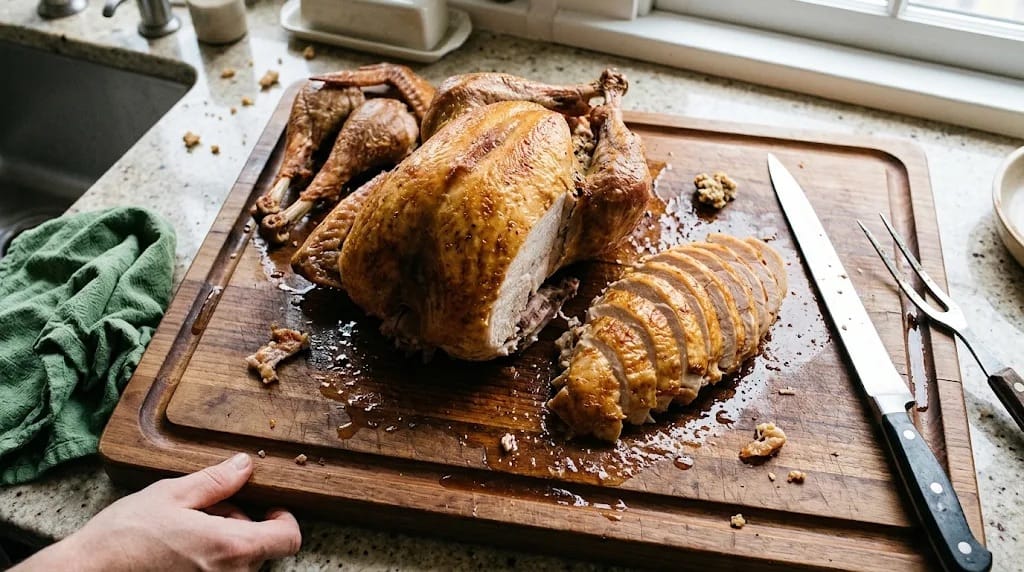
How to Carve a Turkey, Step by Step
Carving a turkey goes faster and looks neater when you do most of it in the kitchen instead of at the table. The method below takes the bird apart at its joints, removes each breast in one piece, and slices the white meat and dark meat on the cutting board, so every slice gets skin and nobody is sawing at a wobbling bird. Here is how to carve a turkey step by step, what you need, how long to let it rest, and how to handle the leftovers safely.
Before you start: check the temperature
Carving starts once the turkey is cooked through. USDA's Food Safety and Inspection Service (FSIS) says a whole turkey is safe when a food thermometer reads 165°F in the thickest part of the breast, the innermost part of the thigh, and the innermost part of the wing. If the turkey was stuffed, the center of the stuffing must also reach 165°F. Our meat cooking temperatures chart lists the safe temperatures for other meats.
How long to rest the turkey before carving
FSIS recommends letting the turkey stand 20 minutes before carving. Resting lets the juices set, so less of them run out onto the board, and the turkey carves more easily. The National Turkey Federation suggests a longer rest, at least 30 minutes and up to an hour, for a large bird. A rested turkey stays hot for a good while, and that window is a good time to make gravy from the pan drippings.
Rest the turkey on its rack or on the cutting board. Tenting it loosely with foil keeps it warmer, but a tight cover traps steam and softens the skin.
What you need to carve a turkey
- A sharp knife. A carving knife or sharp chef's knife at least 8 inches long, ideally 10. A sharp knife with a straight edge cuts clean slices; the National Turkey Federation advises against serrated and electric knives, which can shred the meat. A boning knife is handy around the joints but not required.
- A large cutting board with a juice groove (a carving board), set on a damp kitchen towel so it does not slide.
- A carving fork or a sturdy fork to steady the turkey.
- A second board or a sheet pan to hold pieces as you go, plus a warm serving platter.
- Paper towels and kitchen towels for wiping your hands and the board.
- Kitchen shears (optional) for cutting twine and the backbone of a spatchcocked bird.
If your knives are dull, sharpen or hone them the day before. Our essential kitchen tools list covers a basic knife kit.
How to carve a turkey, step by step
Step 1: Set up and prep the bird
Place the turkey on the cutting board breast side up, with the legs pointing toward you. Cut off any twine. Tip the bird so juices in the cavity pour into the roasting pan for gravy, and discard any aromatics such as onion, herbs, or citrus. If you cooked stuffing inside the bird, FSIS says to remove all of it from the cavity; spoon it into a serving dish.
Step 2: Remove the leg and thigh
Cut through the skin between one leg and the body. Pull the leg away from the body and press it down; the thigh joint will pop out of its socket. Use the tip of the knife to cut through the joint that connects the thigh to the backbone, keeping the knife close to the body so you take the small, tender piece of dark meat on the back (the "oyster") with the leg. Set the whole leg quarter aside and repeat on the other side.
Step 3: Separate the drumstick and thigh
Put a leg quarter skin side down. You will see a line of fat where the thigh and drumstick meet. Wiggle the drumstick to find the joint, then cut straight down through it to separate the two pieces. If the knife hits bone, move it slightly and try again; the joint gives way easily when you find it.
Step 4: Remove the wings
Pull a wing away from the body and cut through the joint where it meets the breast. Some cooks first make a long horizontal cut into the breast just above the wing joint, which also marks the bottom edge of the breast for step 5. Put the wings on the platter.
Step 5: Remove the breast
Find the breastbone running down the center of the top of the breast. Steady the turkey with the fork and cut down along one side of the breastbone. Keeping the knife against the rib cage, use long, smooth strokes to peel the breast meat away from the bone, pulling the meat gently with your other hand as you go. Cut across the bottom where the breast meets the wing joint, and the whole breast half comes away in one piece, skin intact. Repeat on the other side.
Step 6: Slice the breast crosswise
Lay each breast half skin side up on the board. Slice the breast crosswise, against the grain, into slices about 1/4 to 1/3 inch thick. Slicing across the grain makes the white meat more tender to eat, and cutting from a whole breast lets every slice keep a strip of skin. Slide the knife under the sliced breast and move it to the platter in one piece, then fan the slices out.
Step 7: Slice the thigh meat
Turn each thigh skin side down, cut along the thigh bone, and lift the meat off the bone in one or two large pieces. Slice the thigh meat crosswise about 1/3 inch thick. Leave the drumsticks whole for people who want them, or slice the meat off for easier serving.
Step 8: Arrange the platter and serve
Group the white meat and dark meat so people can choose, and add the drumsticks and wings. Spoon a little warm broth or pan juices over the sliced meat to keep it moist. Save the carcass for stock.
Carving at the table instead
If you want to carve at the table, the traditional method leaves the breast on the bird. After removing the legs, make a deep horizontal cut into the breast just above the wing joint. Then, starting halfway up the breast, slice straight down with even strokes until the knife reaches that horizontal cut and each slice falls free. Start each new slice a little higher on the breast. This looks classic but gives you smaller slices, and the outer slices get most of the skin.
How to carve a turkey breast
For a bone-in turkey breast, rest it 20 minutes, then cut down along one side of the breastbone and along the rib cage to lift off each half, as in step 5. Slice each half crosswise. For a boneless turkey breast or roast, cut off any netting and slice crosswise.
How to carve a spatchcocked turkey
A spatchcocked (butterflied) turkey has no backbone, so it is easier to carve. Cut the leg quarters off where the thighs meet the breast, separate the drumsticks and thighs, then cut the wings off. Cut the breast in half down the breastbone, lift each half off the rib cage, and slice crosswise.
Common carving mistakes
- Carving right out of the oven. Skipping the rest means more juice on the board and a harder bird to handle.
- A dull knife. It tears the skin and shreds the white meat.
- Slicing with the grain. Slicing the breast lengthwise gives stringy slices. Remove the breast, then slice it crosswise.
- Fighting the bones. Cut through joints, not bones. If the knife will not go through, wiggle the piece to find the joint.
- A crowded board. Move pieces to a second board or sheet pan as you go, and wipe the board before slicing.
Leftover turkey: food safety
Carving also helps leftovers cool down faster. FSIS advises:
- Refrigerate turkey, stuffing, and gravy within 2 hours of cooking, or within 1 hour if the room is above 90°F. Discard anything left out longer.
- Cut the turkey into smaller pieces before refrigerating. FSIS says to slice the breast meat; legs and wings can stay whole.
- Store leftovers in covered, shallow containers so they cool quickly.
- Use refrigerated leftover turkey within 3 to 4 days. Frozen leftovers are best within 2 to 6 months.
- Reheat leftovers to 165°F, adding a little broth and covering to keep the meat moist.
Leftover dark meat works well in place of chicken in our skillet chicken pot pie with biscuit top.
FAQ
How long should a turkey rest before carving?
FSIS recommends 20 minutes. Larger birds can rest 30 minutes or longer and still be hot when you carve.
What is the best knife to carve a turkey?
A sharp carving knife or chef's knife 8 to 10 inches long with a straight edge. Serrated and electric knives tend to shred the meat.
Should you carve a turkey breast side up or down?
Breast side up. That position gives you access to the leg joints and the breastbone, and keeps the skin on top of the breast.
Can you carve a turkey ahead of time?
Yes. Carve it within the first hour or so after it comes out of the oven, keep the platter covered with foil in a warm spot, and spoon warm broth over the slices before serving. Refrigerate any leftovers within 2 hours.
What do you do with the turkey carcass?
Make stock. Cover the carcass with water, add onion, carrot, and celery, and simmer a few hours. Refrigerate the carcass within 2 hours if you are not making stock right away.
Sources
More like this in your inbox
The Weekly Meal Plan: five dinners and a grocery list, plus new recipes.