
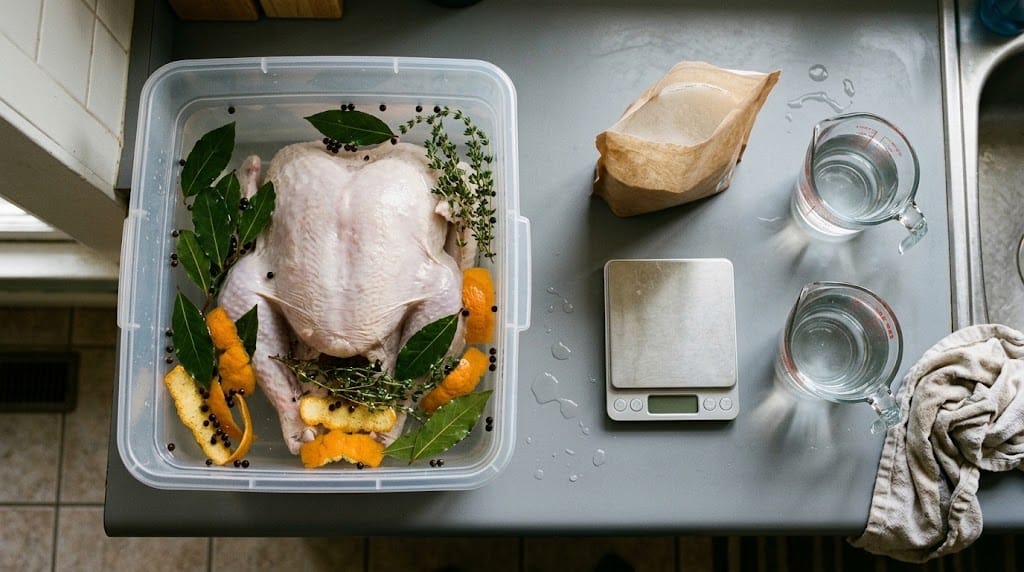
Wet Brine vs. Dry Brine: How to Brine a Turkey
Brining is the simplest way to get a juicy, better-seasoned Thanksgiving turkey, and you can do it two ways. A wet brine soaks the whole turkey in salt water. A dry brine rubs salt straight onto the bird and lets it sit in the refrigerator. Both work, both follow the same food safety rules, and both need a little planning, because the turkey has to be fully thawed before you start. Here is how each method works, the exact salt amounts from USDA, and how to choose between them.
What brining does to a turkey
Brine is a strong solution of salt and water, sometimes with sugar, honey, or molasses added for flavor and browning. According to USDA's Food Safety and Inspection Service (FSIS), salt dissolves some of the protein in the muscle, and the salt and protein together reduce moisture loss during cooking. The result is a turkey that is juicier, more tender, and better seasoned all the way through, not only on the skin.
A dry brine gets the same effect without the bucket of water. FSIS describes it as a process that draws moisture out of the poultry, forms a flavorful brine on the surface, and then lets the meat reabsorb it, without adding extra water.
Wet brine vs. dry brine at a glance
| Wet brine | Dry brine | |
|---|---|---|
| What it is | Turkey fully submerged in salt water | Salt and seasonings rubbed on the bird |
| Salt (USDA FSIS) | ¾ cup salt per gallon of water | 1 tbsp kosher salt per 5 pounds of turkey |
| Time | At least overnight | Up to 2 days |
| Space needed | A container big enough to hold the turkey and several gallons of brine, kept at 40°F or below | A large food-grade bag or a tray on one refrigerator shelf |
| Skin | Absorbs water, so it needs drying time to crisp | Drier surface, crisper skin |
| Drippings | Saltier and thinner | Concentrated, still salty |
| Mess | Heavy lifting and raw-poultry liquid to dispose of | Minimal |
Before you brine: check the label and thaw
- Skip pre-brined turkeys. If the label says "self-basting," "marinated," "for flavoring," or "enhanced," a salt solution was already added at the plant. FSIS says that solution can be up to 3% of the weight of a bone-in bird. Kosher turkeys are also salted during processing. Brining any of these again can make the meat too salty, so look for a turkey with no added solution if you plan to brine.
- Start with a fresh or fully thawed turkey. FSIS recommends thawing in the refrigerator at 40°F or below and allowing about 24 hours for every 4 to 5 pounds. A 16-pound turkey needs 3 to 4 days just to thaw, so count back from Thanksgiving and add your brining time on top. A thawed turkey can stay in the refrigerator 1 to 2 days.
- Do not wash the turkey. USDA advises against washing raw poultry, because the splashing spreads bacteria around the sink and onto nearby food. Remove the neck and giblets and go straight to the brine.
- Make room. Clear a refrigerator shelf, or plan for a cooler and ice.
How to brine a turkey: wet brine
This basic turkey brine recipe follows the simple formula from FSIS: ¾ cup salt per 1 gallon of water, or 3 tablespoons per quart. That measurement is for table salt. Kosher salt is less dense, and brands vary a lot, so the same cup holds less salt. Using King Arthur Baking's ingredient weights, ¾ cup of table salt weighs about 216 grams. The same amount of salt is roughly ¾ cup plus 1½ tablespoons of Morton kosher salt, or about 1⅔ cups of Diamond Crystal kosher salt. If you have a kitchen scale, weigh the salt and skip the conversion.
- Make the brine. Stir the salt into cold water until it is completely dissolved and the water looks clear, not cloudy. Add about ½ cup of sugar or brown sugar per gallon if you like. For aromatics such as bay leaves, peppercorns, a few sprigs of thyme or rosemary, sage, garlic, or orange peel, heat a quart of the water in a large pot on the stovetop with the salt and seasonings, then add the rest of the water as ice or cold water. If your recipe heats the brine solution, cool it to room temperature and then chill it before the turkey goes in. For a cider brine, swap up to half the water for apple cider.
- Pick the right container. FSIS says to use food-grade plastic, stainless steel, or glass, or a food-grade brining bag. Never use a household trash bag. A container large enough to hold the turkey with the brine covering it is the goal; a 12- to 14-pound turkey usually needs about 2 gallons of brine.
- Submerge the turkey. Place the turkey breast side down and make sure it is completely submerged in the brine. Weigh it down with a plate if it floats. Cover the container.
- Keep it cold the whole time. The turkey and brine must stay at 40°F or below for the entire brining process, in the refrigerator or in a cooler packed with ice. University of Illinois Extension suggests 5 to 6 ice packs in a cooler. Put an appliance thermometer in the cooler and check it, adding ice as needed.
- Brine at least overnight. FSIS recommends refrigerating the turkey in brine at least overnight for best results. Longer soaks make the meat saltier, so do not stretch the time just because you can. Remember that the thawed turkey can only stay in the refrigerator 1 to 2 days in total.
- Remove and dry. Lift the turkey out, let the liquid drain into the container, and throw the brine away. Never reuse it. Pat the turkey dry with paper towels, inside and out. For crisper skin, set it on a rack over a tray, uncovered, on the bottom shelf of the refrigerator for several hours or overnight, away from ready-to-eat foods.
- Clean up. Wash the container, the sink, and anything the brine touched with hot, soapy water, and wash your hands.
How to dry brine a turkey
A dry brine is the easier option if you do not have space for a big container of liquid. FSIS's method:
- Measure the salt. Use 1 tablespoon of kosher salt or seasoned salt for every 5 pounds of turkey. A 15-pound turkey gets 3 tablespoons. If you only have table salt or a dense kosher salt, use about half as much, since a tablespoon of those weighs about twice as much as a tablespoon of flaky kosher salt.
- Add seasonings. Mix in herbs, spices, citrus zest, or garlic if you like. Black pepper, dried thyme, and grated orange zest are a classic combination.
- Rub it on. Pat the turkey dry, then rub the mixture over the entire surface of the bird, including the cavity and under the breast skin where you can reach.
- Bag and chill. Place the turkey in a food-grade plastic bag, press out the air, and seal it tightly. Refrigerate for up to 2 days, and massage the salt into the skin every 8 to 12 hours.
- Dry before roasting. Remove the turkey from the bag and pat it dry with paper towels. Do not rinse it.
Which method should you choose?
Both make a moist, well-seasoned turkey, so the choice comes down to your kitchen.
- Choose a dry brine if refrigerator space is tight, if you want crisp, golden turkey skin, or if you are cooking a large bird that will not fit in any container you own. There is no heavy container of raw-poultry liquid to lift or pour out, which is the biggest practical advantage.
- Choose a wet brine if you want to add flavor from apple cider, herbs, and spices in the liquid, or if you are brining a smaller turkey or a turkey breast and have a cooler and plenty of ice. Allow time for the skin to dry before it goes in the oven.
- Skip brining if the turkey is self-basting, enhanced, or kosher, or if anyone at the table needs to watch their sodium.
Cooking a brined turkey
Roast a brined turkey the same way as any other roasted turkey recipe, with a few adjustments:
- Set the oven no lower than 325°F, as FSIS recommends, and use a roasting pan with a rack.
- A brine with sugar browns faster. Lay a loose tent of foil over the breast if the skin darkens before the meat is done.
- Brining does not change the safe temperature. FSIS says a whole turkey is safe at 165°F, measured with a food thermometer in the thickest part of the breast, the innermost part of the thigh, and the innermost part of the wing. Our meat cooking temperatures chart lists every safe temperature in one place, and an instant-read thermometer belongs on any essential kitchen tools list.
- Let the turkey stand about 20 minutes before carving.
- Pan juices from a brined turkey are salty. Taste the gravy before you add any salt, and use low-sodium broth to stretch it.
Common brining mistakes
- Brining a partly frozen turkey. The ice keeps the brine from reaching the meat evenly, and the clock on a thawed bird is already running.
- Leaving it out on the counter or in a warm garage. Brine is not a preservative. Keep the turkey at 40°F or below the entire time.
- Measuring kosher salt by the cup without checking the brand. One cup of one kosher salt can hold twice as much salt as a cup of another.
- Brining a pre-brined bird. Read the label for added solution.
- Washing or rinsing in the sink. Pat the turkey dry instead.
- Putting wet skin in the oven. Dry the turkey well for better browning.
Fresh herbs for the brine or rub keep longer if you store them right; see how to store fresh herbs.
FAQ
How long should you brine a turkey?
For a wet brine using FSIS's ratio, at least overnight. For a dry brine, up to 2 days. In both cases the thawed turkey should not stay in the refrigerator more than 1 to 2 days in total before cooking.
Can you brine a frozen turkey?
No. Thaw the turkey completely in the refrigerator first, then brine it. Remove the giblets and neck once it has thawed.
Do you rinse a turkey after brining?
USDA advises against washing raw poultry because it spreads bacteria. Remove the turkey from the brine, let it drain, and pat it dry with paper towels. Using the right amount of salt is the way to avoid an overly salty bird.
Can you stuff a brined turkey?
FSIS says to brine first, then stuff, and cook immediately after stuffing. For the most even cooking, USDA recommends baking stuffing in a separate dish, and any stuffing must reach 165°F in the center.
Can you brine a turkey for smoking or grilling?
Yes. Either method works for a smoked turkey or a grilled one. Pat the skin dry before it goes on the smoker or grill so it browns instead of steaming. The safe temperature does not change: 165°F in the breast, thigh, and wing.
What kind of salt is best for brining?
Any salt works if you measure it correctly. FSIS writes its wet brine for table salt. Kosher salt dissolves easily and is popular, but brands differ in density, so weigh it or use the conversions above.
Sources
- Poultry: Basting, Brining, and Marinating, USDA FSIS
- Your Safe Thanksgiving Guide, USDA FSIS
- Let's Talk Turkey: A Consumer Guide to Safely Roasting a Turkey, USDA FSIS
- Washing Food: Does It Promote Food Safety?, USDA FSIS
- Brine Method, University of Illinois Extension
- Ingredient Weight Chart, King Arthur Baking
More like this in your inbox
The Weekly Meal Plan: five dinners and a grocery list, plus new recipes.