
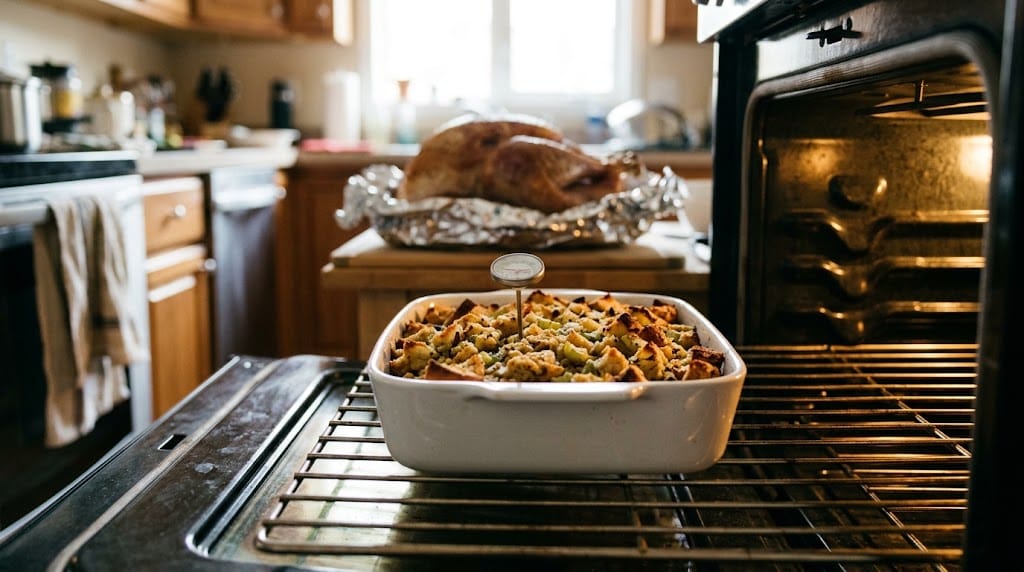
Is It Safe to Cook Stuffing in the Turkey? Why USDA Says Bake It Separately
Short answer: yes, it can be safe to cook stuffing in the turkey, but only if the center of the stuffing reaches 165°F, and that is harder to hit than most people expect. That is why the USDA Food Safety and Inspection Service (FSIS) says that for optimal safety and uniform doneness, you should cook stuffing separately, in a casserole dish. Here is why the agency recommends baking it outside the bird, what to do if you want to stuff your turkey anyway, and how to handle stuffing before and after the meal.
Why USDA says to cook stuffing separately
The problem is physics, not the recipe. When you stuff a turkey, the stuffing sits in the middle of the cavity, the last place the oven heat reaches. FSIS explains that even when the turkey itself has reached a safe minimum internal temperature of 165°F in the thigh, wing, and breast, the stuffing inside may not have gotten hot enough to destroy bacteria.
That matters because stuffing soaks up juices from raw poultry while it cooks. The Centers for Disease Control and Prevention (CDC) notes that raw turkey can carry germs such as Salmonella, Clostridium perfringens, and Campylobacter. Bread stuffing is moist and dense, which FSIS calls an excellent medium for bacterial growth. If the stuffing never reaches 165°F, those bacteria can survive and cause food poisoning.
There is also a culinary cost. To get the center of the stuffing to 165°F, you often have to keep roasting after the turkey is done, which can overcook and dry out the breast meat. N.C. Cooperative Extension points out this same tradeoff: by the time the stuffing is safe, other parts of the bird may be overdone.
What 165°F means for turkey and stuffing
FSIS sets one number for both: 165°F. Check it with a food thermometer in four places:
- The thickest part of the breast
- The innermost part of the thigh
- The innermost part of the wing
- The center of the stuffing
Every spot needs to read at least 165°F. A pop-up timer is not enough; CDC advises using a food thermometer even if your turkey has one. Our meat cooking temperatures chart has the full list of safe temperatures for poultry, beef, pork, and leftovers.
The safer option: bake your stuffing in a casserole dish
Cooking stuffing in a separate dish takes the guesswork out. It cooks evenly, you can check it with one thermometer reading, and the turkey can come out of the oven the moment it is done. FSIS guidance for stuffing cooked outside the bird:
- Mix the wet and dry ingredients just before baking.
- Spoon the stuffing into a greased baking dish and put it in an oven set no lower than 325°F right away.
- Bake until the center of the stuffing reaches 165°F on a food thermometer.
- Plan on at least ½ cup of stuffing per person.
A shallow baking dish heats through faster than a deep one and gives you more crisp edges. A well-seasoned cast iron skillet works too; see our cast iron care guide for keeping it in shape after a wet, savory bake.
How to get turkey flavor without stuffing the bird
Most people stuff the turkey for flavor and moisture. You can get close without the risk:
- Moisten the stuffing with turkey or chicken broth instead of water.
- Once the turkey has reached 165°F and is resting, spoon a few tablespoons of turkey drippings from the roasting pan over the stuffing and return it to the oven to finish.
- Cover the dish with foil for the first part of baking to keep it moist, then uncover it so the top crisps.
Fill the empty turkey cavity with aromatics such as a quartered onion, celery, and herbs instead. They flavor the bird and get thrown away, so there is nothing to undercook.
If you want to stuff a turkey: the USDA rules
FSIS does not forbid stuffing the bird. If you want to stuff your turkey for tradition, these are the steps that keep a stuffed turkey safe to eat:
- Precook raw add-ins. If the stuffing recipe uses raw meat, poultry, or shellfish (sausage, giblets, oysters), cook those ingredients before they go in.
- Mix wet and dry at the last minute. You can prepare and chill the wet and dry ingredients separately ahead of time, but do not combine them until just before you stuff the turkey.
- Stuff loosely. Use about ¾ cup of stuffing per pound of turkey and do not pack it. Tightly packed stuffing heats slowly.
- Keep it moist. FSIS says heat destroys bacteria more rapidly in a moist environment, so stuffing should be moist, not dry.
- Do not cool it first. Hot stuffing can go straight into the turkey cavity. It should be mixed and spooned in right before roasting.
- Roast right away. Put the stuffed raw turkey in an oven set no lower than 325°F immediately.
- Check both temperatures. The turkey and the center of the stuffing both need to reach 165°F. If the meat is done but the stuffing is not, keep cooking. Do not scoop out undercooked stuffing to finish it separately, because it can contaminate the cooked meat.
- Let it stand. Rest the cooked turkey 20 minutes before you remove the stuffing and carve. CDC notes that the rest lets the stuffing cook a little longer.
Cooking time for a stuffed turkey
A stuffed turkey takes longer to cook. These FSIS approximate cooking times are for a fully thawed bird roasted at 325°F:
| Turkey weight | Unstuffed | Stuffed |
|---|---|---|
| 8 to 12 lb | 2¾ to 3 hours | 3 to 3½ hours |
| 12 to 14 lb | 3 to 3¾ hours | 3½ to 4 hours |
| 14 to 18 lb | 3¾ to 4¼ hours | 4 to 4¼ hours |
| 18 to 20 lb | 4¼ to 4½ hours | 4¼ to 4¾ hours |
| 20 to 24 lb | 4½ to 5 hours | 4¾ to 5¼ hours |
Times are a guide only. Oven accuracy, pan type, and how cold the bird is all change the cooking time, which is why the thermometer reading is what counts.
When not to stuff a turkey
FSIS says not to stuff a turkey that will be grilled, smoked, deep-fried, or microwaved. These methods cook the outside fast, and heat may not reach the center of the stuffing in time. FSIS also recommends cooking stuffing in a separate dish rather than inside a stuffed turkey breast for more even cooking.
Make-ahead stuffing: what is and is not safe
- Do not refrigerate uncooked, mixed stuffing. FSIS says raw stuffing should not be prepared ahead and chilled. If you make it ahead, either cook it right away or freeze it.
- Freezing raw stuffing is safe. Combine the ingredients, spread them in a shallow container, and freeze immediately. Bake it from the frozen state, without thawing, until the center reaches 165°F.
- Cooked stuffing can be made ahead. Cool it in shallow containers, refrigerate within 2 hours, use within 3 to 4 days, and reheat to 165°F.
- Never stuff a turkey with leftover cooked stuffing.
- Slow cooker stuffing: FSIS allows it if the stuffing is very moist, the cooker is no more than two-thirds full, it starts on high for at least 1 hour, and the center reaches 165°F. Never put frozen stuffing in a slow cooker.
Store-bought and pre-stuffed turkeys
USDA does not recommend buying a retail-stuffed, uncooked turkey from a store or restaurant. The exception is a frozen turkey stuffed at a plant under USDA inspection, which carries the USDA or state mark of inspection. Cook those from the frozen state, following the package directions, and do not thaw them first. If a commercially pre-stuffed frozen turkey has fully thawed in the refrigerator, FSIS says to discard both the turkey and the stuffing.
If you buy a cooked, stuffed turkey dinner, buy it hot and keep it at 140°F or above, or eat it within 2 hours. If it was delivered chilled, do not accept a whole cooked turkey with the stuffing still inside.
Leftover stuffing and turkey
Remove all stuffing from the turkey cavity before you refrigerate anything. FSIS does not recommend refrigerating a whole cooked turkey with stuffing inside, because the stuffing would take too long to cool below 40°F. Refrigerate leftover turkey and stuffing in separate, shallow containers within 2 hours of cooking, and use them within 3 to 4 days.
Reheat leftover stuffing in an oven set no lower than 325°F or in the microwave until the center reaches 165°F. Do not reheat it in a slow cooker, since it spends too long in the 40°F to 140°F danger zone. CDC notes that Clostridium perfringens, a bacterium that grows in cooked food left at room temperature, causes most of its outbreaks in November and December, many linked to holiday foods like turkey, so getting leftovers into the fridge quickly matters.
The one tool that makes all of this easy is a reliable instant-read food thermometer. It is near the top of our essential kitchen tools list for a reason.
FAQ
Is it safe to cook stuffing in the turkey?
It can be, if you stuff it loosely just before roasting and the center of the stuffing reaches 165°F. USDA still recommends cooking stuffing separately because it is easier to cook evenly and safely.
Why did people stop stuffing turkeys?
Food safety agencies, including USDA and CDC, recommend cooking stuffing in a casserole dish because stuffing inside the bird often lags behind the meat in temperature. Getting it to 165°F can mean overcooking the turkey.
How long should I cook a turkey with stuffing inside?
At 325°F, FSIS estimates 3½ to 4 hours for a 12 to 14 lb stuffed turkey and 4 to 4¼ hours for 14 to 18 lb. Always confirm with a food thermometer in the meat and the center of the stuffing.
Can I stuff the turkey the night before?
No. Stuff the turkey just before it goes in the oven. You can prepare and chill the wet and dry ingredients separately the day before, then combine them right before stuffing.
What if the turkey is done but the stuffing is not 165°F?
Keep the turkey in the oven until the stuffing reaches 165°F. Do not remove undercooked stuffing to finish it on its own, because it can contaminate the cooked meat. For questions on the day, the USDA Meat and Poultry Hotline is 1-888-674-6854.
Sources
- Stuffing and Food Safety, USDA Food Safety and Inspection Service
- Turkey Basics: Stuffing, USDA Food Safety and Inspection Service
- Turkey Basics: Safe Cooking, USDA Food Safety and Inspection Service
- Preparing Your Holiday Turkey Safely, Centers for Disease Control and Prevention
- About C. perfringens Food Poisoning, Centers for Disease Control and Prevention
- Thanksgiving Food Safety Rules, N.C. Cooperative Extension
More like this in your inbox
The Weekly Meal Plan: five dinners and a grocery list, plus new recipes.